
July 14, 2026, | Brian Mitchell
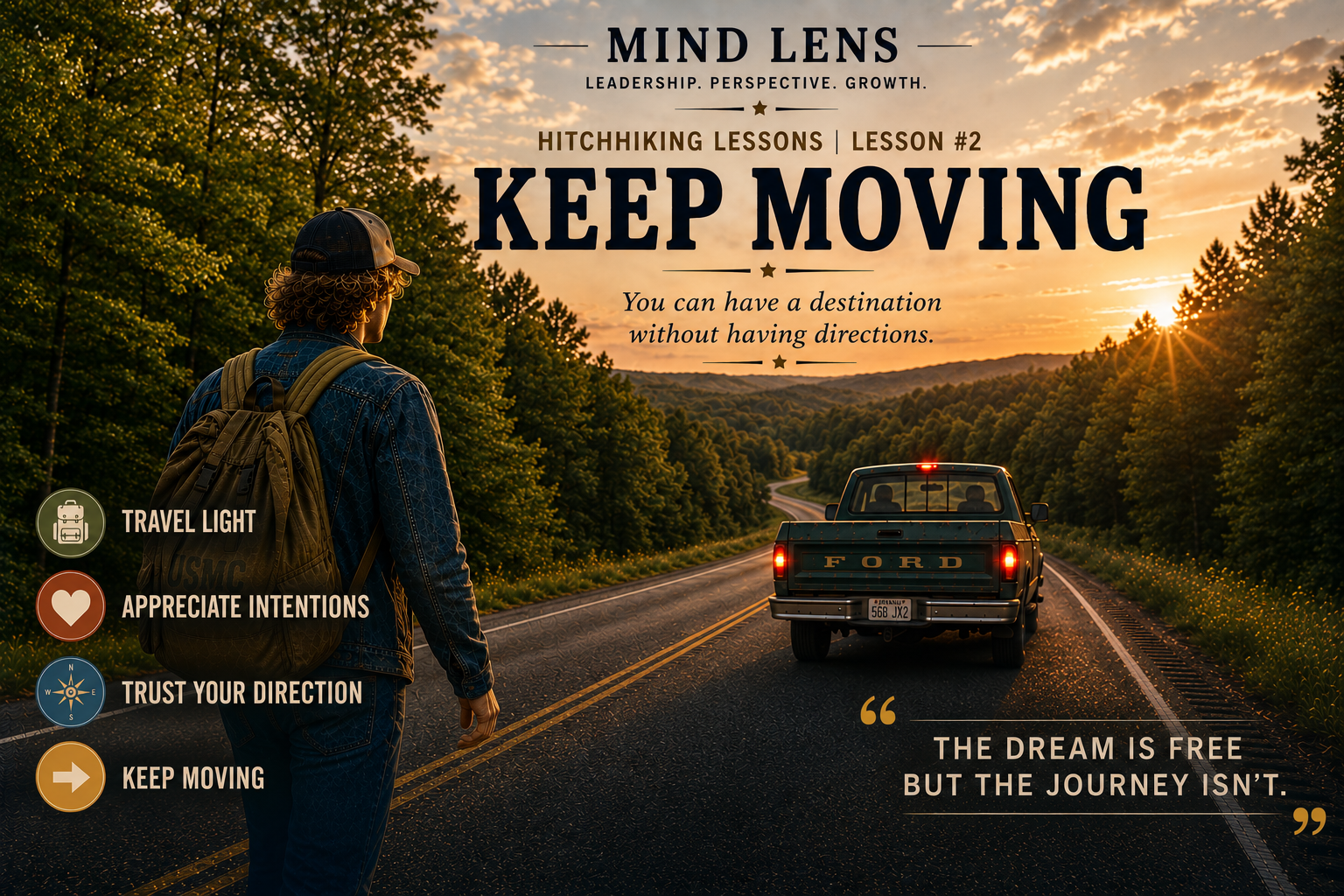
The dream is free. The journey is not.
At the beginning of the second leg of my hitchhiking trip across the country, that reality became painfully clear.
After only one day on the road, the heavy canvas backpack I had so enthusiastically packed was rubbing my shoulders raw. I asked myself, “Why had I brought so much stuff”?
Everything seemed important when I packed it. Carrying it mile after mile provided an unfamiliar perspective. That was a lesson only partially learned. 50 years later, I still occasionally pack too much stuff and that backpack had the proverbial “10lbs in a 5lb bag”.
Leadership can be like that. We begin journeys carrying things we are convinced we will need, like old assumptions, unnecessary processes, outdated practices, fears, expectations and sometimes even past successes (those can be a slippery slope). Eventually we discover that everything we can carry is not necessarily something we should carry.
So, travel light.
Appreciate Intentions
Early that morning, I found myself outside Magnolia, Arkansas, waiting for a ride. Magnolia was a sleepy small town, and the morning rush was not exactly rushing.
Eventually an incredibly old pickup carrying two fellows pulled over. They were genuinely nice guys and quite different from anyone I had encountered before. They put me in the middle seat, drove approximately one-quarter of a mile and pulled over.
“We’re turning here,” the driver announced, with a very southern dialect. At first, I wasn’t sure that I had heard him correctly. That became the shortest hitchhiking ride of my entire trip and my entire life.
Unfortunately, their kindness left me in a worse place to catch the next ride. They dropped me near a stop sign where vehicles were accelerating rather than looking for hitchhikers.
I could have focused on the outcome. Instead, I learned to appreciate the intention. They saw a stranger standing beside the road and tried to help.
Leadership provides plenty of similar moments. People will sometimes help with ideas or advice that do not produce the result we hoped for. That does not diminish the heart behind the effort.
Appreciate good intentions, even when the outcome isn’t what you expected.
Trust Your Direction
Eventually (and I do mean eventually) another pickup stopped. The driver quickly informed me that I could have been standing there for days and that I was fortunate he had come along. Strangers weren’t always readily accepted in those parts. And boy, I was a stranger. A Yankee Doodle Dandy who stood out like a sore thumb (pun intended).
Another ride came from a state representative heading toward the Capitol. Until then, most of what I knew about politicians came from television, newspapers and a political science class in college—which I considered one of the most boring classes I had taken. But he surprised me. He was a nice guy. Ordinary and easy to talk to. Yet another reminder not to let categories determine what we believe about individuals.
Eventually I arrived in Little Rock with another problem. I couldn’t determine which direction was east. It was about midday, so the sun didn’t help me. Remember, there were no smartphones, and no GPS back then. I didn’t even have a Rand McNally map tucked in my backpack.
I studied maps before leaving home. I knew where Vermont was. I understood generally where I needed to go. But I did not have turn-by-turn directions. So, I asked.
I told a service station attendant that I was headed to Vermont. That didn’t help much because he had no idea where Vermont was. So, I asked if he knew of New York. He said, “Oh yeah!” So, I told him, “It’s just the other side of New York.” The light went on and he joyously pointed me east.
Looking back, there was an important lesson there. I had a destination without having directions. Leadership frequently works the same way. We would love a detailed map showing every turn, obstacle and decision ahead. Most of the time, we do not get one. So, we prepare, we study, we determine where we are trying to go, and then we begin.
When we are not sure which direction to take, we ask (if we are wise). Asking for directions is not an admission that we lack confidence. Sometimes it demonstrates enough confidence to admit that we do not know.
Prepare carefully. Know where you are trying to go. Ask when you need help. Then trust your direction.
Learn From Everyone
My next ride on Interstate 40 came from an LSU art professor. He was a cool Dude. He drove a Volkswagen Microbus that struggled to exceed 40 miles per hour going uphill, and there was a bottle of Old Crow whiskey sitting between us. Yuck! That stuff was awful.
We talked for hours. We asked questions and we learned about each other’s lives. By the time we reached Nashville, something else was becoming increasingly clear to me. There are kind and interesting people in every walk of life.
Two local fellows in an old pickup – A confident stranger – A politician – A service station attendant – An art professor driving a VW Microbus. They had diverse backgrounds, different experiences, different perspectives and every one of them became part of my journey.
Leadership becomes very limiting when we believe learning flows only from the leader to everyone else. Every person we encounter knows something we do not, and every person has experienced something we have not. Everyone can teach us something, if we are curious enough to ask and humble enough to listen.
Keep Moving
By the time I reached Nashville, it was around 9:00 on Friday night. I was exhausted, I was grubby, and I had every reason to stop. but something inside me wanted to continue. My goal was simple: Get east of Nashville.
I didn’t know who would stop next, I did not know how far that person would take me, I didn’t know where I would sleep, I couldn’t pull out my phone and see the route ahead, but I did know the direction. East. So, I stuck out my thumb again.
There are times in leadership when that is enough. You don’t always need to know exactly where the road will take you.
Sometimes you simply need enough confidence in your direction to keep moving and to travel light, appreciate intentions, learn from everyone, and trust your direction. And when the road ahead remains uncertain— to keep moving.
Because leadership is not about having every answer before beginning the journey. It is about preparing well, knowing where you are trying to go, remaining open to the people and lessons you encounter along the way, and having enough courage to take the next step when you can’t see what’s ahead.
That night outside Nashville, I stuck out my thumb once again to continue my quest. What happened next may have been one of the turning points of my life. But that’s a story for the next Hitchhiking Lesson.
Leadership will change your life — I guarantee it.

Comments
This was great. I enjoyed reading this very much Brian. I thank God for you.