Mindful Reflection: FORE Letter Word
Golf has a way of teaching humility.
Recently, I played a round while battling a stiff back. Every swing seemed to remind me that time catches up with all of us. As the round progressed, frustration began creeping in—something every golfer understands.
Golf looks easy. It isn’t.
A game that appears simple can quickly expose weaknesses in focus, patience, and emotional control.
Have you ever heard of a solution? I have.
Author and speaker Margaret Feinstein, during a talk one day, offered a solution that included four elements she described as “red neck golf.” Red neck golf is not particularly different from conventional golf with minor exceptions including these:
1. You cannot pay more than $25 a round to play because your behavior would get you kicked off more expensive golf courses. Good luck with that these days, Margaret.
2. All par 4 holes became par 8 – plus 2 or “par 10” holes. People have talked about increasing the size of the hole, but not red neck golf – that would be too easy!
3. If, while playing red neck golf you find additional balls you subtract the number of found balls from your score. So much for shortening the time of play.
4. There must be goodies to indulge in during the round that would vary depending on the age and preference of those playing.
Margaret also referred to golf (described by her father) as being so named ”golf” because it was the last remaining four-letter word in the dictionary. Experiencing the frustration that can overcome a human being when playing golf is an experience like few others. Being rendered helpless, hopeless and humbled is not a feeling of delight. For those of you now chuckling, you either already know, or may I say to you – “try it and you too may grow to love to hate it.”
I’ve seen frustration take many forms on the golf course.
I once heard a playing partner talk about being in a foursome where a gentleman hit a poor tee shot and then proceeded to pitch his bag full of clubs into a pond. Two conclusions to draw from that incident: 1) the player was extremely frustrated and 2) that turned out to be an expensive round of golf. You will notice that I did not label the player a “bad person.” He may, however, have made an unwise decision.
The same thing happens in leadership.
When organizations face pressure, shrinking margins, or uncertain markets, leaders can react much like frustrated golfers. The temptation is to make quick decisions simply to relieve immediate discomfort.
One of the most common examples is excessive cost-cutting.
Prudent spending is important. Every organization should be disciplined with resources. However, when cost reduction becomes the primary strategy, innovation, creativity, employee engagement, and growth often suffer.
In healthcare, education, business, and virtually every industry, leaders face increasing costs and growing expectations. The challenge is not simply to cut expenses. The challenge is to improve performance – while simultaneously creating opportunities for growth.
Growth and profitability are not opposing goals!
The strongest organizations pursue both.
They engage employees in problem-solving. They encourage innovation. They create accountability while investing in development. They focus on improving processes, service, and outcomes rather than merely reducing expenditures.
The question is not, “How much can we cut?”
The better question is, “How can we become better?”
Sometimes the answer requires new thinking, change, and a willingness to challenge longstanding assumptions. Yet those are often the very conditions that produce meaningful innovation.
Operating the same old way is not the answer in a profitability shrinking environment.
Change must occur and with a focus on improvement versus reduction is more often the answer to growth and profitability.
It may require external thinking and finding ways outside your existing environment to get better and more profitable at what you do. Uncomfortable decisions to change may just be the enabling factors that trigger positive innovation.
Without it:
- Margins will inevitably continue shrinking as the cost-cutting measures run dry.
- Growth will likely diminish or disappear altogether –
- leaving but a shell of an organization as opposed to a vibrant organism.
Which brings us back to golf.
Every golfer eventually faces a choice. We can allow frustration to define the round and throw our bag into the lake, or we can keep our sticks and refocus on the next shot.
Leadership presents the same choice.
You can approach business challenges either of these ways:
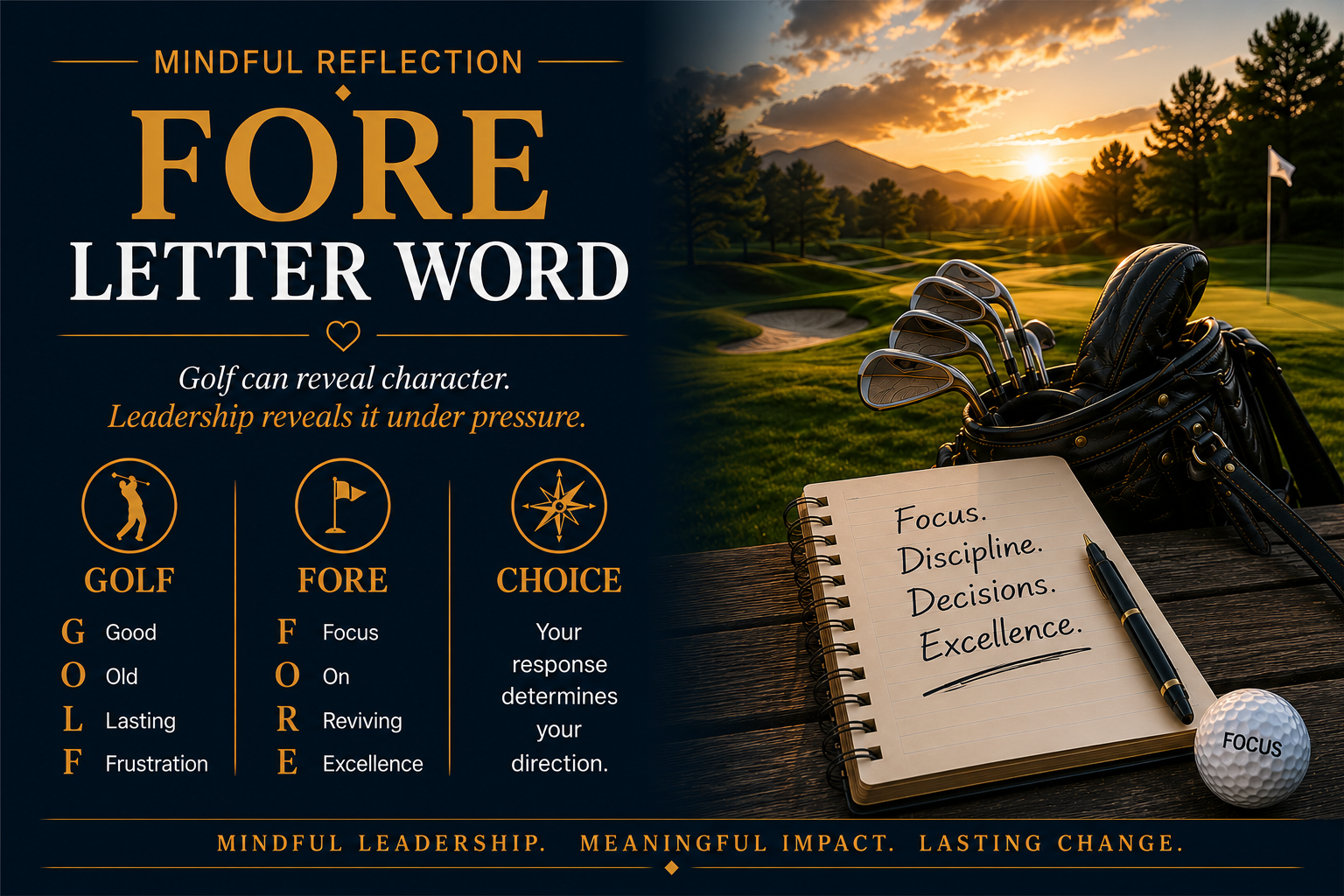
1) The last four-letter word:
G – good
O – old
L – lasting
F – frustration
2) Or a different four-letter golfing word referring to how you attack the opportunity:
F – focus
O – on
R – reviving
E – excellence
The choice determines the direction.
Leadership, like golf, is often won or lost one decision at a time. FORE!!!