
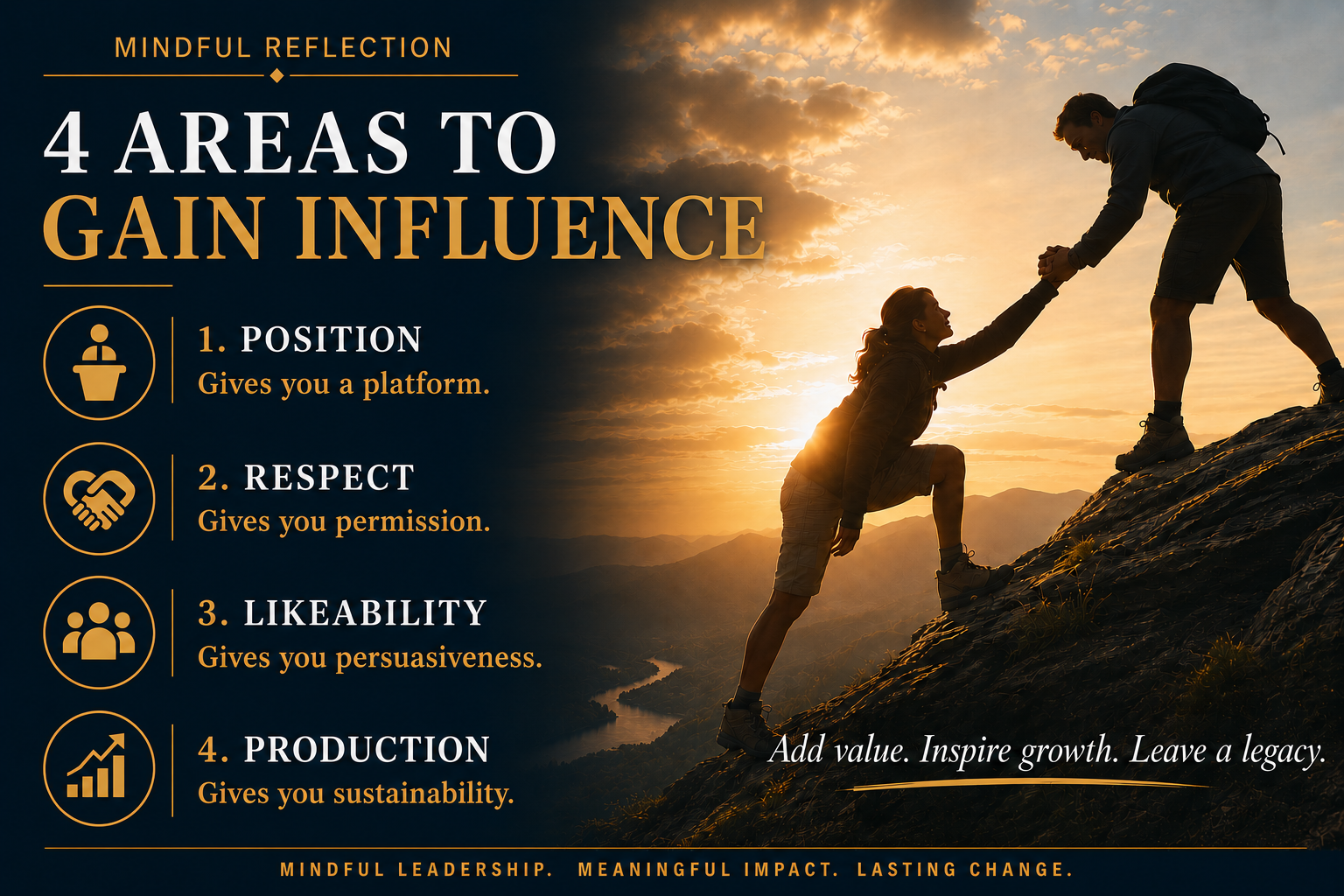
Mindful Reflection: 4 Areas to Gain Influence
Leadership is influence.
John Maxwell has said that for years, and the longer I lead, the more convinced I become that he is right. But not all influence is the same. Some influence is rooted in fear, title, control, or intimidation. Other influence is grounded in service, encouragement, trust, and genuine concern for others. The influence I’m talking about here is the second kind.
It is not loud, forceful, or self-promoting. It doesn’t depend on bullying or positional authority. It is the kind of influence that helps people grow, feel valued, and become more successful because your leadership touched their lives positively. People follow leaders when they believe those leaders genuinely have their best interests in mind.
That kind of influence doesn’t happen accidentally. It grows over time, and as it grows, leadership capacity grows with it. Healthy growth shines like a beacon of light. Negative growth, on the other hand, casts a shadow people eventually notice and avoid.
A while ago, I revisited this topic after listening to Mark Cole and Chris Robinson of Maxwell Leadership. Their discussion reinforced something I deeply believe leadership is not primarily about gaining followers, but about adding value to people.
John Maxwell said it this way:
“Leaders who attract followers want to be needed. Leaders who attract leaders want to be succeeded.”
That statement gets to the heart of mature leadership.
So how do we expand our positive influence in ways that genuinely help others? I believe there are four key areas:
1. Position Gives You a Platform
A title may open the door to leadership, but it does not guarantee influence.
Position provides a platform or a starting point. What we do with that opportunity determines whether people truly follow us, because leadership is still about people.
It is easy, especially after working hard to achieve a leadership role, to drift toward entitlement or arrogance. Most leaders who fall into that trap don’t do so intentionally. Success can quietly whisper that we deserve greater importance. It can be a subtle but slippery slope.
Leadership is not a right to be exercised over people. It is a privilege entrusted to us for the benefit of people.
Gratitude and humility protect leaders from abusing the platform they’ve been given. People may initially follow a title, but they stay committed to leaders who treat them with dignity and respect.
2. Respect Gives You Permission
Respect is one of the strongest foundations of influence.
Interestingly, respect is rarely built during easy seasons. It is usually earned during pressure, adversity, conflict, or uncertainty. Challenging moments reveal how leaders communicate, respond, and carry themselves. And respect grows when people know they matter.
That begins with questions like:
- What can I do to help you succeed?
- How can I add value to your team?
- Did I serve you in the way you needed?
Leadership rooted in respect does not begin with “Here’s what I need from you.” It begins with “How can I help?”
And if we want respect, we must first give it. People respond differently when they feel seen, heard, and appreciated. Respect creates permission for influence because it creates trust.
3. Likeability Creates Connection
This point sometimes makes leaders uncomfortable because “likeability” can sound superficial. But real likeability is not about popularity, it is about connection. People go along with people they get along with.
Healthy leadership relationships are built on genuine interest in others as human beings, not simply as workers or contributors. Strong leaders understand that people carry entire lives outside the workplace — families, struggles, dreams, responsibilities, disappointments, and hopes. And all that matters.
I learned a great deal about leadership simply by paying attention to the interests and experiences of people around me. One teammate taught me about Little League leadership. Another taught me about elk hunting. Those conversations were not leadership strategies; they were moments of authentic interest and connection.
Maya Angelou (American poet, author, and civil rights activist, 1928–2014) said it beautifully:
“People will forget what you said, people will forget what you did, but people will never forget how you made them feel.”
Influential leaders make people feel valued. Empathy, attentiveness, encouragement, and genuine curiosity build bridges that authority alone never can.
4. Production Creates Sustainability
Influence cannot survive without contribution.
At some point, leadership must produce something meaningful. Leaders who only direct without participating eventually lose credibility.
Good leaders contribute.
That does not mean they do everything themselves, but it does mean they stay connected to the mission and are willing to step alongside their team when needed.
I remember coaching soccer as I grew older and realizing I could no longer physically demonstrate certain techniques the way I once had. So I adapted. I slowed things down, broke mechanics into smaller parts, and stayed engaged in the teaching process.
Participation matters.
People appreciate leaders who pull on the rope with them. There is credibility in shared effort and influence in visible commitment.
As leaders, we should never ask others to do something we ourselves would refuse to do if we were capable.
A Final Reflection
Influence expands leadership capacity. In many ways, influence is leadership.
But the most meaningful influence is not manipulative or self-serving. It is encouraging, motivating, and edifying. It helps others grow stronger, wiser, and more confident.
Position may give us a platform.
Respect may give us permission.
Connection may give us persuasion.
Production may give us sustainability.
But genuine care for people gives leadership its lasting impact.
When we consistently add value to others, influence grows naturally.
And that kind of influence changes lives.
Leadership will change your life — I guarantee it.