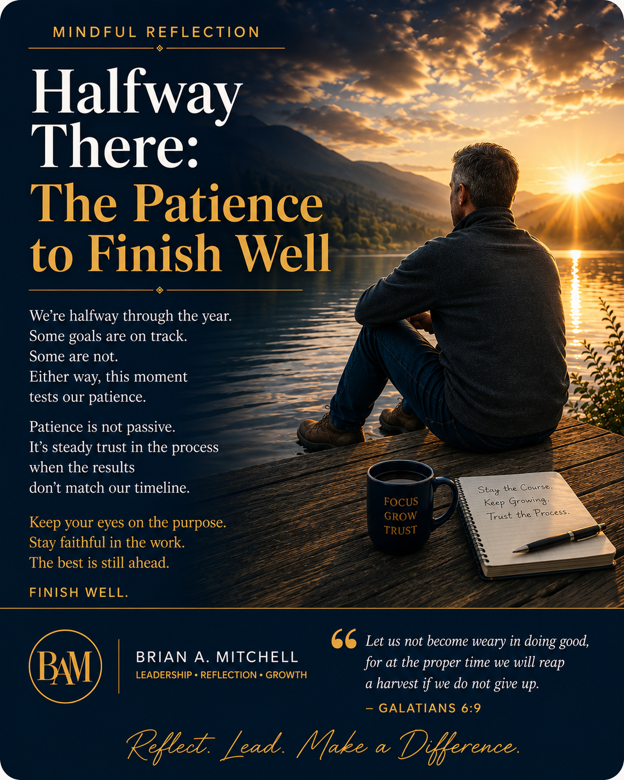
Mindful Reflection: Halfway There – The Patience to Finish Well
July 20, 2026 | Brian Mitchell
Have you ever heard someone say, “Be careful what you pray for?”
Years ago, I prayed for patience.
Since then, I seem to have encountered one situation after another that has tested it.
Delays. Detours. Unmet expectations. Slow progress. Difficult people. Unfinished goals.
Perhaps you can relate.
The older I get, the more I believe patience is not developed in peaceful moments, but in frustrating ones. Patience grows when life refuses to move at the speed we prefer.
And if we are honest, mid-year can be one of the most difficult seasons for that.
By July, many of us realize we are not where we hoped we would be.
The goals we set in January may still feel far away. The progress we expected may not have materialized. Projects remain unfinished. Habits are inconsistent. Growth feels slower than anticipated.
That reality tests us.
The real question is not whether those moments come, but how we respond when they do.
What Patience Really Means
If you search for the definition of patience, you’ll find words like:
- tolerance
- restraint
- endurance
- the ability to accept delay or difficulty without becoming angry or upset
That sounds wonderful in theory.
In practice, it can be much harder.
Most of us naturally drift toward impatience when things fail to go our way. Some people react quickly with frustration or anger. Others slowly lose composure over time until discouragement or negativity begins to surface.
I know I have.
The truth is that emotions are real. We do not simply switch them on and off like light bulbs. Anger, disappointment, discouragement, excitement, and joy often rise before we consciously process them.
What we can influence, however, is how we manage and direct those emotions.
That matters.
What We Feed Grows
I often think of the mind and nervous system somewhat like a computer.
What we continually feed into it shapes how it responds.
Poor input usually produces poor output.
If our minds are constantly filled with negativity, comparison, selfishness, outrage, fear, or resentment, patience becomes difficult to sustain. Our emotional responses become increasingly reactive.
But the opposite is also true.
Positive influences help cultivate patience.
Encouraging conversations. Inspiring books. Thoughtful reflection. Uplifting music. Healthy relationships. Prayer. Gratitude. Time spent with emotionally grounded people.
Those things slowly shape the way we respond to adversity.
Patience is not merely a personality trait.
In many ways, it is something we cultivate.
When Passion Works Against Us
One of the more surprising obstacles to patience can actually be passion.
Passion is usually viewed positively—and often it should be. Passion fuels commitment, purpose, energy, and perseverance.
But passion without emotional discipline can become destructive.
A strong desire for results can quickly become frustration when progress feels too slow.
Ever been there?
I certainly have.
Momentum is powerful, whether positive or negative. Left unchecked, negative momentum can damage relationships, cloud judgment, and create consequences that linger long after the emotional moment has passed.
That is why patience matters so much.
Patience slows us down long enough to think clearly.
Patience protects us from reacting impulsively.
Patience helps us respond wisely instead of emotionally.
And perhaps most importantly, patience reminds us that meaningful growth rarely happens overnight.
Progress Is Usually Slower Than We Prefer
One of the great frustrations of life is that growth tends to occur gradually.
Character develops slowly.
Leadership develops slowly.
Trust develops slowly.
Healing develops slowly.
Even physical goals, financial goals, family goals, and spiritual growth often take far longer than we hoped they would.
We live in a culture addicted to immediacy, but life rarely cooperates with our preferred timeline.
That does not mean growth is absent.
It may simply mean we are still in process.
Over the years, I do believe I have become more patient.
Not perfectly patient.
Just more patient.
And that growth did not happen suddenly. It happened through repetition, setbacks, reflection, failures, and learning moments I would not have chosen for myself.
Small Moments of Patience Matter
Sometimes patience is practiced in very ordinary ways.
When someone is late, I try to use the waiting time productively instead of becoming irritated. I may send an encouraging message to a friend, read a devotional, catch up on an article, or simply pause and reflect.
Other times, I remind myself of the occasions when I was the late one.
That perspective humbles me.
It softens the emotional reaction.
Patience often grows when we remember that everyone—including ourselves—is imperfect.
Forgiveness helps with that.
Scripture repeatedly teaches the importance of extending grace to others because we ourselves constantly need grace.
That truth has a way of calming the spirit.
Not There Yet
At mid-year, it is easy to become discouraged because we are not where we hoped to be.
But perhaps growth is not measured only by how far we have gone.
Perhaps it is also measured by:
- how we handle adversity,
- how we treat people under pressure,
- how we respond to delay,
- and whether we continue moving forward without giving up.
“Rome wasn’t built in a day” remains true because meaningful things usually take time.
Patience is not passive resignation.
It is disciplined perseverance.
It is continuing to move forward with steadiness even when results are delayed.
And maybe that is why patience is called a virtue.
Not because it is easy.
But because it is valuable.
A Final Reflection
At this point in the year, you may not yet be where you hoped to be.
Honestly, neither am I.
But growth is rarely linear, and life is not lived according to perfect timelines.
So perhaps the goal is not perfection by mid-year.
Perhaps the goal is continued growth.
Continued faith.
Continued effort.
Continued learning.
Continued patience.
Because in time, patience has a way of producing wisdom, perspective, healthier relationships, and inner peace.
The ride may be long.
But it is still worth taking.
Leadership will change your life — I guarantee it.