
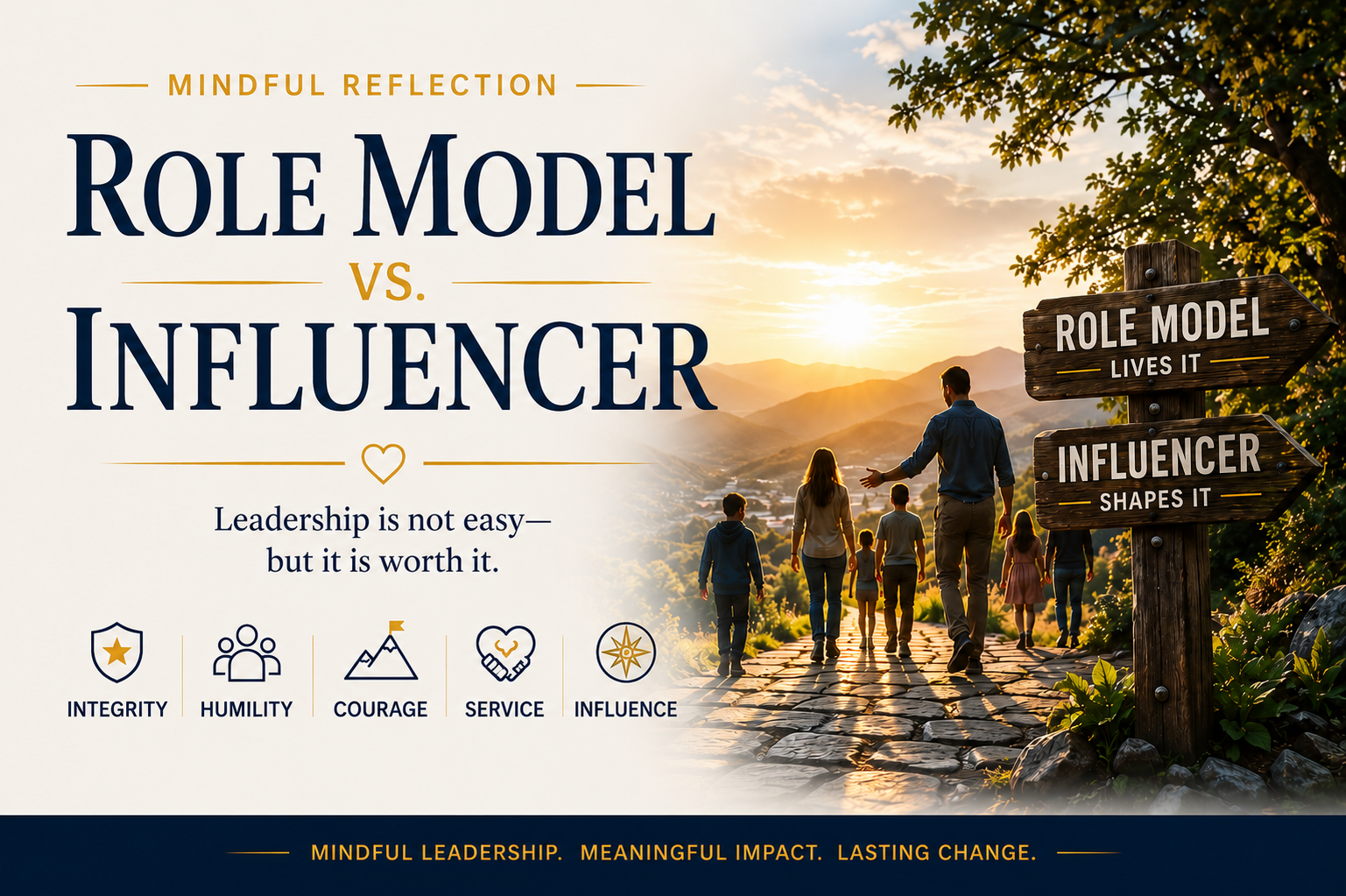
Mindful Reflection
Role Model vs. Influencer
Leadership is not easy—but it is worth it.
Whether you lead as a parent, CEO, coach, teacher, janitor, or teammate, leadership always requires the same things: intention, effort, courage, humility, and the willingness to keep going after you fall short.
And leaders do fall short.
The reality is that leaders are often noticed more closely than they realize. People watch what leaders do, not merely what they say. Expectations rise when someone consistently demonstrates integrity, discipline, or wisdom. Others begin believing that person will continue doing the right thing because that is what they have repeatedly modeled.
That reality recently came back to mind while reflecting on comments made years ago by sports commentator Jason Whitlock during a Martin Luther King Jr. Day broadcast.
Whitlock spoke very positively about Dr. King as a role model, and rightly so. But he contrasted that with modern athletes and celebrities whom he labeled as influencers. His argument suggested that many influencers are primarily self-promoters—people selling products, brands, and themselves to the highest bidder.
To be fair, there is truth in that observation.
Professional athletes and celebrities are often paid enormous sums to promote products. Companies invest heavily in advertising, and recognizable public figures are part of that business model. Brett Favre sold jeans. Terry Bradshaw promoted walk-in tubs. Michael Jordan sold everything from shoes to underwear.
None of that is particularly shocking.
What caught my attention was not the business side of the discussion, but the apparent separation between being a role model and being an influencer.
A role model is commonly defined as someone whose behavior is worthy of imitation. An influencer is someone capable of affecting the thoughts or actions of others.
At first glance, those definitions seem different.
But are they really?
Influence Is Leadership
John Maxwell has long taught that leadership is influence.
Not position.
Not title.
Not power.
Influence.
He also says:
“A leader is great not because of his power, but because of his ability to empower others.”
That distinction matters.
Influence, at its best, should encourage growth, initiative, confidence, and positive change in others. Properly used, influence becomes a force for helping people become better versions of themselves.
That is why I struggle with drawing too sharp a line between role models and influencers.
In my mind, the best influencers are role models.
Or at least they should strive to be.
The Responsibility of Influence
The real issue is not whether influence exists. Every leader, parent, teacher, athlete, manager, and public figure influences someone.
The real issue is how that influence is used.
Whitlock’s concern, as I understood it, was that some influential people use their platform primarily for personal gain rather than for the benefit of others. He seemed to long for individuals whose lives inspire people toward character, discipline, service, and growth rather than consumption or celebrity.
Frankly, that concern is understandable.
Too much modern influence is self-focused.
But influence itself is not the problem.
Leadership without influence accomplishes very little. Influence without character, however, can become dangerous.
That is why influence and role modeling should not be separated from one another. They should work together.
More Than Visibility
Over the years, I have also reconsidered another leadership phrase I used to repeat often:
“Managers do things right. Leaders do the right things.”
At one time, I liked that statement.
Today, I believe it unfairly lets managers off the hook.
If you manage people, you are leading people.
And if you are leading people, character matters.
Titles and responsibilities do not exempt us from the obligation to model integrity, humility, consistency, and service. In fact, they increase that responsibility.
That is true whether someone leads a Fortune 500 company, coaches Little League baseball, supervises a maintenance team, or raises children.
Leadership is not merely about accomplishing tasks. It is about influencing lives.
The Best Leaders Do Both
History gives us powerful examples of people who were both role models and influencers.
Martin Luther King Jr. was both.
Mother Teresa was both.
Nelson Mandela was both.
Fred Rogers was both.
Their influence extended far beyond words because their lives reinforced their message.
None of them were perfect. But at the core of their leadership was a genuine desire to help others, elevate humanity, and pursue what was right.
Ancient scripture describes Joshua as possessing “the spirit of leadership.” I’ve always found that phrase fascinating because it suggests leadership is more than skill or charisma. It speaks to character, intention, and the heart behind influence.
That may be the greatest distinction of all.
A Final Reflection
Influence is neither inherently good nor inherently bad.
Its value depends on the spirit behind it and the purpose for which it is used.
Used selfishly, influence manipulates.
Used wisely, influence elevates.
That is why leadership matters so much.
People are always watching.
Children are watching.
Employees are watching.
Families are watching.
Communities are watching.
The question is not whether we influence others.
We do.
The real question is this:
Are we using our influence in ways that genuinely help people grow?
Because when influence is grounded in integrity, humility, encouragement, and service, role models and influencers stop competing with one another.
They become one and the same.
Leadership will change your life — I guarantee it.


Comments
Great content! Keep up the good work!